


 |
 |
|
 |
 |
 |
 |
|
 |
|
||||||
 |
 |
 |
 |
 |
 |
|
|
|
|||||||
 |
 |
 |
 |
 |
|
||
 |
 |
 |
|
||||
|
|||||||
|
|
|
|
|
|
|
|
|
|
||||||
|
|
|
|
|
|
|
|
|
|||||||
|
|
|
|
|
|
||
|
|
|
|
||||
|
|||||||


Three ships in the United States Navy have been named USS Jouett for James Edward Jouett.
* The first USS Jouett (DD-41) was a Paulding-class destroyer launched in 1912, served in World War I.
She served in the United States Coast Guard from 1924 to 1930. She was sold in 1934.
* The second USS Jouett (DD-396) was a Somers-class destroyer launched in 1938,
served in World War II and decommissioned in 1945.
* The third USS Jouett (DLG-29) was a Belknap-class Guided Missile Cruiser
launched in 1964 and decommissioned in 1994.

USS Jouett DD 41
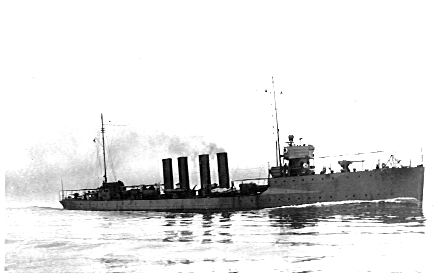
Displacement: 787 ton
Length: 293'11" Beam: 27 Draft: 8'4"
Speed: 30 k.
Armament: 5 3" ff 18" tt.
Class: Monaghan
Built at Bath Iron Works and commissioned 24 May 1912
The first Jouett (DD-41) was laid down 7 March 1911 by Bath Iron Works, Ltd., Bath, Maine, Iaunched 15 April 1912;
sponsored by Miss Marylee Nally; and commissioned at Boston 24 May 1912, Lt. Comdr. W. P. Cronan in command
Jouett joined the Atlantic Fleet Torpedo Flotilla and operated off the East Coast until early 1914,
when events in Mexico threatened American interests and officials at Tampico arrested American sailors
without cause. Jouett supported the landing of Marines at Vera Cruz 21 April 1914.Returning to the
East Coast after this operation, the destroyer continued to carry out training maneuvers until the
United States entered World War I in April 1917. The ship was assigned patrol in Delaware Bay
in April 1917 and remained on that duty until sailing from New York 8 August 1917 as an escort for
five troopships bound for France .After returning from Europe, Jouett resumed patrolling until she arrived
New London, Conn., 15 January 1918 for experimentation with antisubmarine detection devices.
Completing this duty 4 June 1918, the ship operated until the armistice with a special antisubmarine group along the East Coast of the United States.
Following the war Jouett conducted training exercises and fleet maneuvers until entering
Philadelphia Navy Yard 20 July 1919. She decommissioned 24 November 1919 and remained inactive until being
loaned to the Coast Guard 23 April 1924 for use as a cutter.
Returned to the Navy 22 May 1931 she was sold for scrap to Michael Flynn Inc., Brooklyn, N. Y.
If you have any pictures please forward them to the webmaster.

USS Jouett DD 396
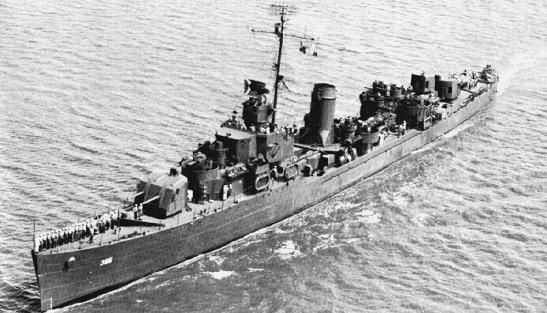
Somers Class Destroyer
Displacement: 1850 tons
Length: 381'0" Beam: 36'2" Draft: 16'6"
Speed: 35 knots
Armament: 5 5"/38, 8x4 21" torpedo tubes
Complement: 294 High-pressure geared turbines with twin screws, 52,000 h.p.
Built at Bath Iron Works and commissioned 25 January 1939
The second Jouett (DD-396) was laid down 26 March 1936 by Bath Iron Works Corp., Bath, Maine,
Launched 24 September 1938; sponsored by Mrs. J. R. Todd;
and commissioned at Boston 25 January 1939, Comdr. G. W. Clark in command.
Following shakedown training which took Jouett to England and Ireland, the ship returned to
Norfolk 29 April 1939 and began operating on neutrality patrol along the East and Gulf Coasts.
She stood out of Pensacola Bay 15 February 1940 as one of the escorts for Tuscaloosa (CA-37),
carrying President Roosevelt on a cruise through the Gulf of Panama, returning to Pensacola 1 March 1940.
Jouett then set course for the Panama Canal and the Pacific, arriving Pearl Harbor for duty 10 April 1940.
The destroyer remained in Hawaiian waters during the next year exercising with America's vital carriers
and perfecting tactics. Sailing 18 April 1941, Jouett accompanied Yorktown (CV-5) through the canal to Cuba,
proceeding from there to Port-of-Spain, Trinidad, 19 May. The ship then joined a cruiser and destroyer force
under Rear Admiral Jonas H. Ingram charged with guarding against German surface or submarine attacks
on American shipping. Jouett was at Port of Spain 7 December 1941 when the Japanese attack on
Pearl Harbor brought America into the war. The ship then began offensive antisubmarine patrols between
Brazil and Africa, helping to keep the all-important ocean supply lines open. She accompanied Army engineers
to lonely Ascension Island 30 March 1942 where an airfield was carved from the bleak landscape.
Jouett convoyed the precious oil tankers from Trinidad south during the months that followed,
often attacking submarines with depth charges. In December 1942, the ship returned to Charleston for repairs,
but by 21 January 1943 she was back in Natal harbor, Brazil.
Jouett received President Vargas of Brazil 27 January 1943, providing quarters for him and his
party during important conferences on board Humboldt (AG 121) with President Roosevelt.
Following the talks, which cemented relations between the countries and
provided for closer naval cooperation, President Vargas departed Jouett 29 January.
The veteran destroyer resumed her escort duties in February, and 14 May joined in the search for U-128
off Bahia, Brazil. Aircraft dropped depth charges on the sub and brought her to the surface where gunfire
from Jouett and Moffett (DD-362) sent her to the bottom. The destroyer continued to serve with
Admiral Ingram's crack antisubmarine force, now 4th Fleet, through the rest of 1943.
On New Year's Day 1944 she joined Omaha (CL-4) for ocean patrol; and the ships intercepted German
blockade runner SS Rio Grande, with a vital cargo of crude rubber. After the crew abandoned ship,
Omaha and Jouett sank the German ship. This effective closing of the South Atlantic to German blockade
runners was demonstrated even more forcefully 5 January when patrol planes reported a
strange ship identifying herself as Floridian. Intelligence identified her, however, as blockade
runner Bergenlund. Before aerial attacks could begin Omaha and Jouett picked
her up on radar and closed in. Scuttling charges and the cruiser's gunfire sank her just after 1730.
Jouett returned to Charleston once more in March 1944 and engaged in training operations in
Casco Bay, Maine, before sailing for England in convoy 16 May 1944. There she joined a
Reserve Fire Support Group for the long awaited invasion of France. Jouett arrived off
Omaha beach 8 June, escorting coastal steamers with support troops embarked. She repelled an air attack
that day, and until 21 June screened British heavies during shore bombardment and provided antisubmarine
screen for the Omaha Beach transport area. The second front established,
Jouett escorted convoys to and from the Firth of Clyde until 12 July 1944 when she sailed with a convoy for Algeria.
The destroyer arrived at Oran 21 July to prepare for the next major European operation, the invasion
of southern France. Departing Naples 14 August, Jouett arrived off the Delta assault area next day
and, as troops landed, acted as command ship of the Convoy Control Group charged with the smooth
routing and unloading of support troops. This duty continued until 3 September, after which the ship
operated on patrol out of Toulon. In early October Jouett steamed off Cape Ferrat, giving gunfire support
to American troops in the bitter fighting ashore. She also destroyed mines off
San Remo 9 October, destroyed bridges, and covered Allied minesweeping operations in the area.
Jouett sailed from Oran 31 December 1944 for repairs at Charleston. After refresher training in
Casco Bay in April, the battle tested ship made convoy voyages to England and Cuba before the end
of the war 15 August 1945. She decommissioned at Philadelphia Naval Shipyard 1
November 1945 and was scrapped there in 1946.
Jouett received three battle stars for World War II service.


Last Updated 1/25/14